Published by MHM – Mena Hospitality Market
The Evolution of Alternative Accommodation and Its Impact on Hotel Investment
Furnished apartments are not a new concept in the accommodation market.
For decades, they have provided an alternative to traditional hotels, particularly for families, business travelers, and guests seeking longer stays, more space, or greater privacy.
Yet despite the existence of both supply and demand, furnished apartments historically operated within a relatively fragmented market, often relying on individual property owners, local brokers, and personal connections.
The challenge was not necessarily a lack of demand. It was the difficulty of connecting guests with available accommodation.
Technology fundamentally changed this relationship.
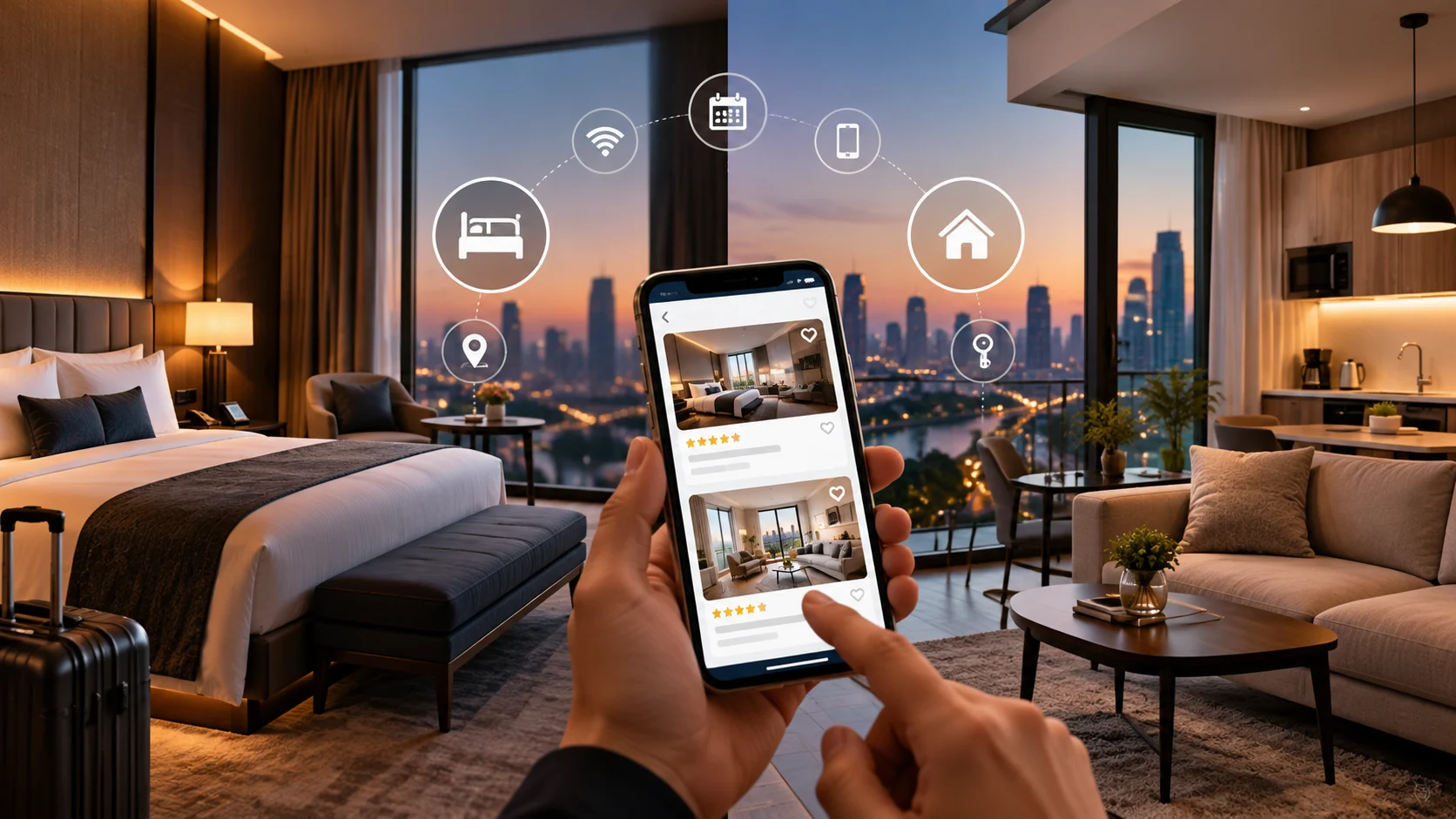
The rise of online booking platforms, digital reviews, and professional property management companies transformed how furnished apartments are discovered, marketed, booked, and operated.
What was once largely a locally distributed rental product has become an increasingly accessible accommodation option for travelers around the world.
And in the process, it has become a more visible competitor to traditional hotels.
1. Furnished Apartments Always Existed — But Access Was Limited
Before digital booking platforms became widely available, finding a furnished apartment in an unfamiliar city could be a significant challenge.
In many markets, travelers had to visit neighborhoods personally, contact local real estate brokers, approach building caretakers, or rely on recommendations from friends and acquaintances.
Even after identifying an available apartment, uncertainty remained.
Was the property clean and properly maintained?
Was its location convenient?
Did the apartment actually match its description?
What would happen if the guest arrived and discovered that the accommodation did not meet expectations?
These concerns created significant barriers, particularly for international travelers unfamiliar with local markets.
Hotels, by comparison, enjoyed a clear competitive advantage.
Guests could make reservations in advance, identify the hotel's location and classification, and rely on more predictable service standards, especially when booking an established international brand.
Hotels offered three advantages that furnished apartments often struggled to match: accessibility, predictability, and trust.
These advantages were not simply related to the physical hotel product. They were also rooted in distribution, booking infrastructure, and consumer confidence.
2. Technology Did Not Create the Product — It Changed the Market
The expansion of digital platforms such as Airbnb, Booking.com, and Expedia fundamentally changed how travelers search for accommodation.
Today, guests can explore hotels, serviced apartments, and professionally managed rental properties within the same destination.
They can compare prices, locations, photographs, amenities, and previous guest reviews before completing a reservation and, where supported, making payment online.
This significantly reduced the information and accessibility barriers that had historically limited the reach of furnished apartments.
A traveler who might previously have hesitated to rent an apartment from an unfamiliar owner can now make a more informed decision based on publicly available information, guest feedback, and the booking platform's services.
This does not eliminate the risks associated with alternative accommodation, nor does it guarantee consistent quality.
However, it has narrowed an important part of the information and trust gap between hotels and independently operated accommodation.
Technology didn't create furnished apartments. It made them easier to discover, compare, and book.
More importantly, digital distribution did not merely shift existing reservations from offline channels to online platforms.
It also helped attract guests who might previously have avoided furnished apartments because of uncertainty, limited information, or the difficulty of arranging a reservation.
In this way, technology potentially expanded the addressable market for alternative accommodation.
3. From Individual Landlords to Professional Property Management
Digital booking platforms were only one part of the transformation.
Operating an apartment for short- or medium-term stays is fundamentally different from leasing a residential property under a conventional annual contract.
It involves frequent reservations, guest communication, housekeeping, maintenance, pricing adjustments, check-in and check-out procedures, and ongoing review management.
For individual property owners, these responsibilities can be demanding.
As the market developed, specialized property management companies expanded their services to support short- and medium-term accommodation.
These companies increasingly offer:
- Reservation management and distribution across booking platforms.
- Dynamic pricing and revenue optimization.
- Housekeeping and cleaning services.
- Guest communication and check-in coordination.
- Maintenance and property inspections.
- Review management and guest experience monitoring.
- Financial reporting for property owners.
This helped transform part of the furnished apartment market from individually managed rentals into a more structured accommodation business.
Owners could increasingly participate in the market without personally handling every operational responsibility.
Professional management helped transform individual rental units into scalable accommodation businesses.
An important distinction remains, however.
Not every furnished apartment listed on a digital platform qualifies as a serviced apartment.
Professional management, service standards, licensing, and regulatory requirements vary significantly across markets.
4. How Furnished Apartments Became an Investment Product
As distribution became easier and professional management services expanded, the investment proposition began to change.
Traditionally, residential property investors often relied on long-term leases or personally managed shorter rentals.
Digital distribution and third-party management introduced another option.
Investors could acquire residential units, furnish them for guest accommodation, and appoint specialized companies to manage reservations, operations, and marketing in exchange for management fees or a share of revenue.
This model made short- and medium-term accommodation more accessible to a wider group of property investors.
It also encouraged interest in purpose-designed serviced apartments and residential developments incorporating professional rental management.
However, the potential for higher gross rental revenue should not be confused with higher investment returns.
Short-term accommodation may involve additional costs, including furnishing, refurbishment, utilities, cleaning, maintenance, platform commissions, management fees, and periods of vacancy.
Licensing requirements and local restrictions may also affect operational flexibility.
Investment performance must therefore be evaluated through net operating income, cash flow, capital expenditure, and return on invested capital rather than gross rental revenue alone.
Nevertheless, the combination of digital distribution and professional management helped make alternative accommodation a more commercially accessible investment category.
Technology improved market access. Professional management improved operational scalability. Together, they helped expand the investment market.
5. When Did Furnished Apartments Become Real Hotel Competitors?
Competition between furnished apartments and hotels did not begin with technology.
Guests have always considered apartments for their additional space, privacy, flexibility, and potential cost advantages.
What technology changed was the scale and visibility of that competition.
Historically, hotels and furnished apartments often reached customers through different distribution channels.
Today, a hotel room and a managed apartment may appear within the same online search results, allowing guests to compare them directly.
Accommodation decisions are increasingly influenced by the value each product offers rather than its classification alone.
A family requiring two bedrooms and a kitchen may prefer an apartment over booking multiple hotel rooms.
An executive staying for a month may prioritize living space, laundry facilities, and overall cost.
Meanwhile, a business traveler staying for two nights may prefer a hotel with 24-hour reception, restaurants, meeting facilities, and standardized services.
Not every apartment competes with every hotel.
However, certain guest segments now have a broader range of accessible accommodation alternatives.
Competition is no longer defined only by property type. It is increasingly defined by guest needs.
6. Corporate Long-Stay: A Growing Area of Competition
Corporate long-stay demand represents one of the clearest areas of overlap between hotels and professionally managed apartments.
This segment includes executives on temporary assignments, international consultants, project teams, relocating employees, and professionals working away from their primary residences.
Their stays may extend from several weeks to several months.
As the length of stay increases, priorities can shift toward living space, kitchen facilities, laundry services, privacy, and total accommodation cost.
This may give serviced apartments an advantage over certain traditional hotel products.
However, hotels are not necessarily disadvantaged.
Extended-stay hotel brands and properties offering apartment-style accommodation, flexible services, and competitive long-stay rates can address many of the same requirements.
The competitive question is therefore not simply whether hotels or apartments are superior.
It is which accommodation model best serves a particular demand segment.
7. Branded Residences: Another Source of Competitive Accommodation Supply?
The expansion of branded residences adds another dimension to the market.
Branded residences are not necessarily hotels or serviced apartments.
They are residential properties associated with a brand, often purchased for personal use, investment, or a combination of both.
However, some developments allow owners to participate in rental programs managed by professional operators.
Where regulations and operating arrangements permit, these units may compete for short-, medium-, or long-stay accommodation demand.
This creates an important distinction between:
Hotel Room Supply
and
Effective Accommodation Supply
A destination may contain a relatively limited number of conventional hotel rooms while also offering a substantial inventory of professionally managed apartments and rental residences.
Yet these units should not automatically be counted as equivalent hotel rooms.
A two-bedroom apartment may accommodate a different guest profile, generate different revenue, and remain available for rent for only part of the year.
Understanding effective accommodation supply requires examining rental participation, actual availability, permitted stay lengths, operating models, and target demand segments.
8. Did Technology Create New Demand or Redistribute Existing Demand?
This is one of the most important questions in evaluating the growth of alternative accommodation.
Two different effects may occur.
The first is Demand Substitution.
This happens when a guest chooses a managed apartment instead of a hotel they might otherwise have booked.
In this case, alternative accommodation captures part of the existing hotel demand.
The second is Demand Creation.
This occurs when greater accessibility, more suitable accommodation options, or lower overall costs encourage additional travel, longer stays, or bookings from guests who previously avoided the market.
Both effects can occur simultaneously.
Some reservations may shift away from hotels, while the overall accommodation market expands.
Therefore, it would be misleading to assume that every night booked in an apartment represents a room night lost by a hotel.
Equally, it would be misleading to assume that alternative accommodation has no impact on hotel performance.
Alternative accommodation can both expand the market and redistribute demand within it.
Determining the balance between these effects requires evidence about guest behavior, booking patterns, and market segmentation.
9. Why Hotel Feasibility Studies Must Evolve
Traditional hotel feasibility studies typically begin by evaluating competing hotels within a defined market.
However, where professionally managed apartments and alternative accommodation are widely available, limiting the analysis to conventional hotels may produce an incomplete picture of competition.
For a hotel targeting corporate long-stay guests, relevant competitors may include serviced apartments and professionally managed rental properties offering similar accommodation solutions.
This requires evaluating more than hotel room counts.
A comprehensive assessment may also examine online accommodation listings, pricing, guest reviews, length-of-stay patterns, service standards, and the presence of professional management operators.
This leads to an important concept:
Demand-Based Competitive Set
Competitors should be identified according to the demand segments they serve, rather than property classification alone.
A convention hotel may compete most directly with other hotels offering substantial meeting facilities and group capacity.
An extended-stay hotel may face more direct competition from professionally managed apartments.
This distinction can influence occupancy, ADR, RevPAR, positioning, development scale, and ultimately investment feasibility.
A hotel feasibility study should evaluate the accommodation options available to its target guests — not just the hotels operating nearby.
10. Does This Threaten the Future of Traditional Hotels?
Not necessarily.
Traditional hotels continue to offer important advantages, including comprehensive services, restaurants, meeting facilities, loyalty programs, recognized brands, and more standardized operating environments.
Many guests will continue to prefer hotels because of convenience, service expectations, and the overall hospitality experience.
What has changed is the historical distribution advantage that hotels once enjoyed.
Technology has made alternative accommodation easier to access, while professional management has helped improve the operational consistency of some competing products.
Hotel developers must therefore understand not only why guests would choose their hotel over another hotel, but also why they would choose it over other accommodation options.
Conclusion: Technology Did Not Create Furnished Apartments. It Changed the Rules of Competition.
The evolution of furnished apartments into professionally managed accommodation was not simply a change in terminology.
It reflected a broader transformation in distribution, property management, guest experience, pricing, and investment accessibility.
Online platforms reduced barriers to discovery and booking.
Professional management companies helped individual units operate within more structured accommodation models.
Together, these developments increased the commercial reach of alternative accommodation and intensified competition with certain hotel segments.
For hotel investors and developers, the implications extend beyond operational competition.
They challenge how accommodation supply should be measured and how hotel feasibility studies should define the competitive market.
The question is no longer simply:
How many hotels are competing in this market?
It is increasingly:
How many accommodation options are competing for the same guest?
Because a hotel's most relevant competitor may not be another hotel.
It may be a residential unit that has become just as easy to discover and book, while offering an accommodation experience better suited to a particular guest's needs.
Technology didn't create the accommodation. It changed the market.
MHM – Mena Hospitality Market
Hospitality Development & Investment Insights